2 hours ago
18
2 hours ago
18
Published August 24, 2026 2:17 PM CDT
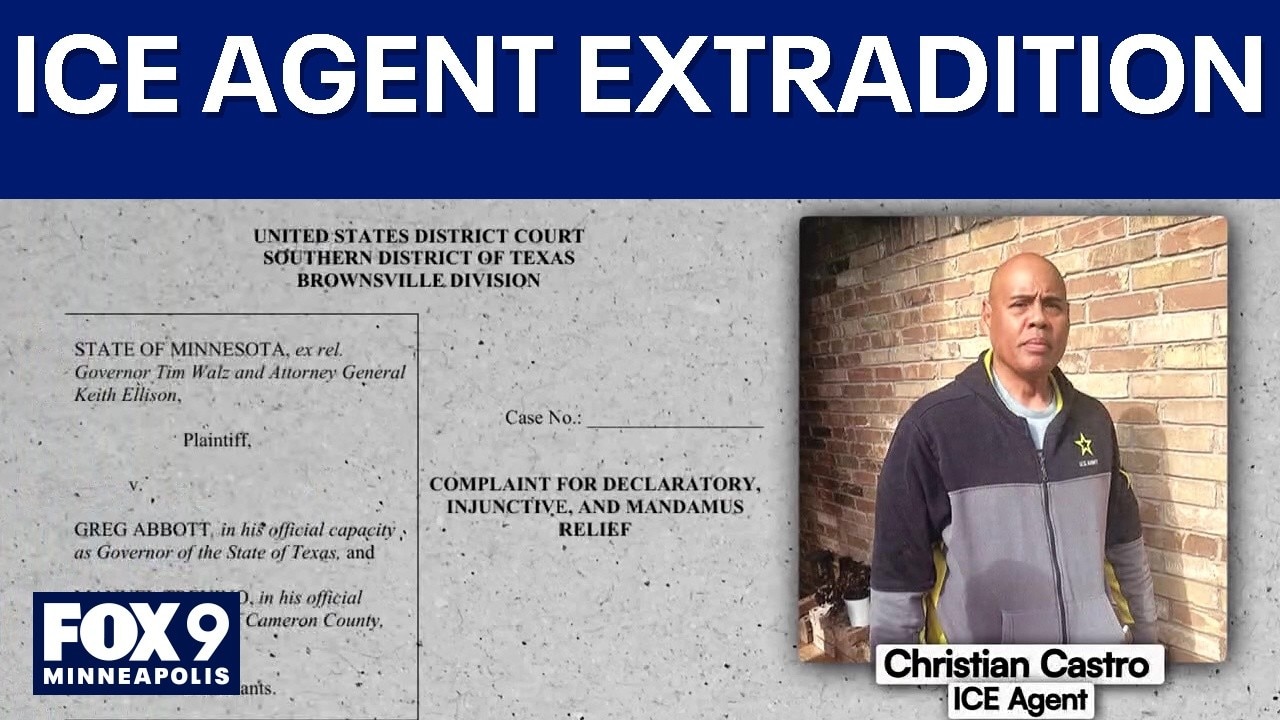
ICE agent extradition: MN sues TX Gov. Abbott
Time is running out in a dispute between Minnesota Gov. Tim Walz and Texas Gov. Greg Abbott regarding the extradition of an ICE agent accused of shooting a man in the leg and then lying about it. FOX 9's Paul Blume has the latest details and spoke with All Day's Courtney Godfrey about what comes next.
(FOX 9) - Texas Governor Greg Abbott's office has responded to a lawsuit brought by Minnesota Attorney General Keith Ellison, seeking to force the extradition of an ICE agent involved in a Minneapolis shooting.
Abbott responds
What we know:
Last week, Ellison filed a federal lawsuit trying to force Texas to move forward with the extradition of ICE agent Christian Castro, who faces charges in Hennepin County related to the shooting of an immigrant in Minneapolis in January.
In his lawsuit, Ellison argued that the state is up against a crucial deadline this week, as Texas law only allows an individual to be held for a maximum of 90 days while awaiting extradition. Castro's 90 days expires this Thursday.
Ellison argued that there is evidence that Castro is a potential flight risk, citing jailhouse calls between him and a woman in Mexico where Castro discussed plans to buy a house in Mexico and live there with her.
Last week, Abbott responded to the lawsuit saying he didn't "trust Tim Walz on anything, let alone something like this." He also added he had "demands" of his own, calling on Minnesota to "repay the United States" for fraud.
What they're saying:
In his response, Gov. Abbott leans on three key arguments:
- Because it's a state versus state matter, the Supreme Court should decide on the case: Abbott argues the District Court is the wrong venue for this case.
- The lawsuit is not ripe because Abbott hasn't officially made a decision on the extradition.
- Minnesota's case fails on its merits: Abbott's office states the Texas governor has the power to decide whether the conditions are met for the extradition. Abbott says he is waiting on a determination from his Secretary of State to determine if Castro meets the legal definition of a "fugitive."
- Texas doesn't see Castro as a true flight risk and officials argue they could issue a "rendition" warrant and arrest Castro at a later date if all conditions are met for his extradition after the 90-day deadline expires.
For the "fugitive" aspect of the arguments, Abbott's attorneys say Castro didn't voluntarily leave Minnesota to avoid the criminal case. He was ordered to return to his home station by the Department of Homeland Security after Operation Metro Surge was wrapped up.
Abbott argues that if Castro was ordered to return to Texas, the mandatory duty to extradite him may not have been triggered. However, it's worth noting that, regardless, the Hennepin County judge has issued a warrant for Castro's arrest in the case and the reason Castro is in jail is because of that warrant.
What's next:
An emergency hearing is set for Tuesday in Brownsville, Texas on the lawsuit ahead of Castro's potential release on Thursday. The judge in the case could issue a ruling this week that could block Castro from being freed from the Cameron County Jail.
The Cameron County Jail is located in Brownsville, which is a border town directly across from Matamoros, Mexico.
Castro case background
The backstory:
Castro was arrested in Cameron County, Texas in late May, shortly after he was charged in Hennepin County. However, despite efforts by Gov. Walz, Ellison, and the Hennepin County Attorney's Office, Governor Abbott has not signed the papers to move forward with the extradition.
Minnesota officials say the delay is unusual, and the extradition process is an "administrative" procedure. Last week, as the lawsuit was filed, Ellison pointed out that Gov. Abbott had signed off on at least three other extraditions requested by Governor Walz at the time that Castro had been in jail.
Local perspective:
Castro was charged by Hennepin County Attorney Mary Moriarty with multiple felony counts, including four counts of second-degree assault and falsely reporting a crime following the shooting of Venezuelan immigrant Julio Sosa-Celis in January during Operation Metro Surge.
Sosa-Celis was shot in the leg during an incident on 24th Avenue North on January 14. Castro initially claimed he was attacked with a broom and shovel before firing his service weapon. However, surveillance video and witness testimony contradicted Castro's claims. Sosa-Celis's family said he was in the county legally under temporary protected status.
The shooting of Sosa-Celis came a week after the shooting of Renee Good and ten days before the shooting of Alex Pretti. Like the Good and Pretti shootings, the Sosa-Celis shooting sparked a night of unrest in the north Minneapolis neighborhood. The scene became so tense that federal government squads left behind at the scene were looted and vandalized that night.
Crime and Public SafetyMinneapolis