10 hours ago
20
10 hours ago
20
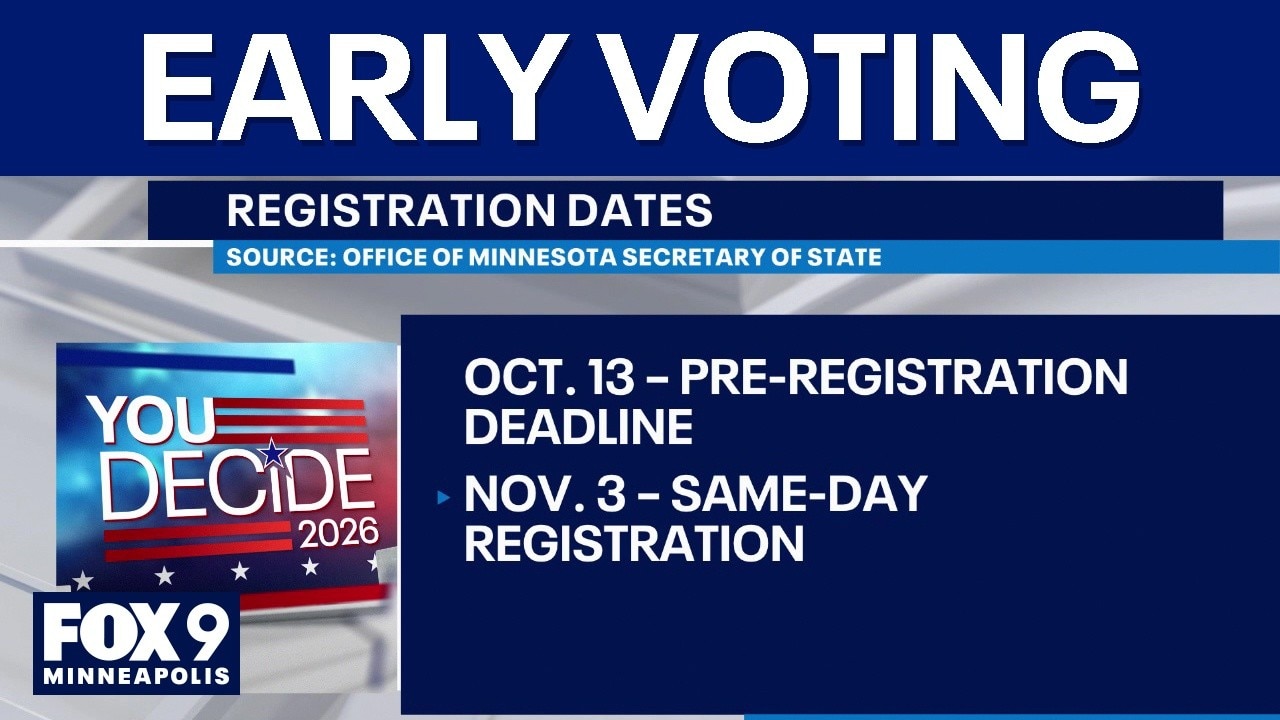
(FOX 9) - Minnesota's 2026 general election is Nov. 3, and in-person early voting begins Friday, Oct. 16. Here’s how to vote early, request an absentee ballot, register to vote and find your polling place.
Minnesota early voting dates for 2026
What we know:
Minnesota voters can cast ballots before Election Day through absentee voting, mail voting and in-person early voting.
Here are some important dates you need to know:
- Absentee ballots available — Sept. 18
- In-person early voting begins — Oct. 16
- Recommended deadline to apply for an absentee ballot — Tuesday, Oct. 20
- Final day to vote early in person — Nov. 2
- Election Day — Nov. 3
Vote early in person
What we know:
Early voting will be available for voters beginning on Friday, Oct. 16.
This year, early voting will now be more like voting on Election Day. Voters will be able to fill out a ballot and feed it directly into a tabulator.
Each county is required to have at least one location for early voting. For most counties, the early voting center is located at a government center or county courthouse. However, some counties – like Hennepin and Ramsey counties, for example – have multiple centers set up in government centers, city halls, churches, and universities across the counties.
You can click here to find an early voting center in your county.
Where to vote early in person
Find a location:
Each county is required to have at least one location for early voting. For most counties, the early voting center is located at a government center or county courthouse. However, some counties – like Hennepin and Ramsey counties, for example – have multiple centers set up in government centers, city halls, churches, and universities across the counties.
You can click here to find an early voting center in your county.
Absentee voting
Anyone eligible to vote in Minnesota can submit an absentee ballot.
Requesting an absentee ballot:
Minnesota voters can apply online for an absentee ballot. You can also download an absentee ballot application and return the complete application to your county by email, mail or fax.
You do not need to be registered to vote to apply for an absentee ballot. If you are not yet registered to vote, you will be sent voter registration materials with your ballot.
Officials recommend you apply for an absentee ballot at least two weeks before Election Day. The recommended deadline to apply for an absentee ballot for the 2026 general election is Tuesday, Oct. 20.
How to return your ballot:
There are three ways to return your absentee ballot:
- Return your ballot by mail
Your ballot will not count if it is not received by Election Day, regardless of when it was postmarked. You can track your absentee ballot here.
- Drop off your ballot
Ballots must be returned no later than 5 p.m. on Election Day and must be returned to the office that sent the ballot during office hours. However, some jurisdictions do have ballot drop boxes that can be used 24 hours a day.
- Have someone else drop off your ballot
A person can drop off ballots for up to three other voters. They will need to show identification with name and signature when returning a ballot for someone else.
Dig deeper:
Some rural cities and towns in Minnesota vote by mail. They send ballots to every registered voter instead of having an Election Day polling place. Ballots sent to voters this way may be returned by mail or dropped off at the election office as late as 8 p.m. on Election Day.
How to register to vote in Minnesota
What you can do:
You can check your voter registration here.
Online voter registration is now closed, but you can still apply for an absentee ballot even if you are not yet registered to vote. You will be sent voter registration materials with your ballot.
You can also register to vote or update your voter registration at your early voting location or at your polling place on Election Day.
What to Bring:
To register at your early voting location or at your polling place on Election Day, you will need to bring one proof of residence.
ID with current name and address
- Valid Minnesota driver’s license, learner’s permit or ID; or a receipt for any of these.
- Tribal ID with name, address, photo and signature.
Photo ID and a document with current name and address
Approved photo IDs (the ID can be expired):
- Driver's license, state ID or learner’s permit issued by any state
- U.S. Passport
- U.S. Military or Veteran ID
- Tribal ID with name, signature and photo
- Minnesota university, college or technical college ID
- Minnesota high school ID
Approved documents (can be shown on an electronic device):
- Bill, account or start-of-service statement due or dated within 30 days of the election. Some options include a phone, TV or internet bill, a bank or credit card statement or bill or a solid waste, sewer, electric, gas or water bill.
- Residential lease or rent agreement valid through Election Day
- Current student fee statement
Registered voter who can confirm your address
A registered voter from your precinct can go with you to the polling place to sign an oath confirming your address – known as 'vouching.' A registered voter can vouch for up to eight voters, but you can’t vouch for others if someone vouched for you.
You can find more information on how to register to vote here.
What's on the ballot?
Big picture view:
All Minnesota voters will have these races on their general election ballot:
- U.S. Senator
- U.S. Representative
- Governor and Lt. Governor
- Secretary of State
- State Auditor
- Attorney General
- State Senator
- State Representatives
- Constitutional Amendment
- Judicial Seats
Some voters may have one or more of these races on their ballot:
- County Officials
- City Officers
- School Board Members
- Township Officers
- Local ballot questions
Information on your specific ballot and what choices may be on it can be found here.
The Source: Information in this story comes from the Minnesota Secretary of State website.
ElectionMinnesotaPolitics2026 Elections